
10 Distribution Board Types Explained

Distribution board types are classified by function, protection method, and installation context. The main types include Main Distribution Boards (MDB), Sub Distribution Boards (SDB), consumer units, transfer switches, and meter panels.
Selecting the right distribution board types depends on load capacity, circuit protection requirements, and compliance with IEC 61439 and SASO standards mandatory in Saudi Arabia. Engineers evaluate voltage rating (230V/400V), form of separation, and environmental IP rating during specification.
This guide explains the 10 most common distribution board types used in commercial, industrial, and residential projects across the GCC region.
Quick Answer:
Distribution boards are classified into 10 main types based on function and application:
- Main Distribution Board (MDB): Primary incoming supply distribution
- Sub Distribution Board (SDB): Secondary circuit distribution from MDB
- Consumer Unit: Residential/light commercial with integrated RCD
- Fuse Box: Legacy protection using replaceable fuses
- Main Lug Panel: No main breaker, fed from upstream device
- Vertical Per-Phase Isolation DB: Independent phase control
- Phase Selector DB: Multi-source switching capability
- Enclosed Switchgear: Metal-clad high-current assembly
- Transfer Switch: Automatic/manual dual-source switching
- Meter Panel: Energy monitoring and billing equipment
The right type depends on load capacity, voltage rating (230V/400V), protection requirements, and installation environment.
Distribution Board Types
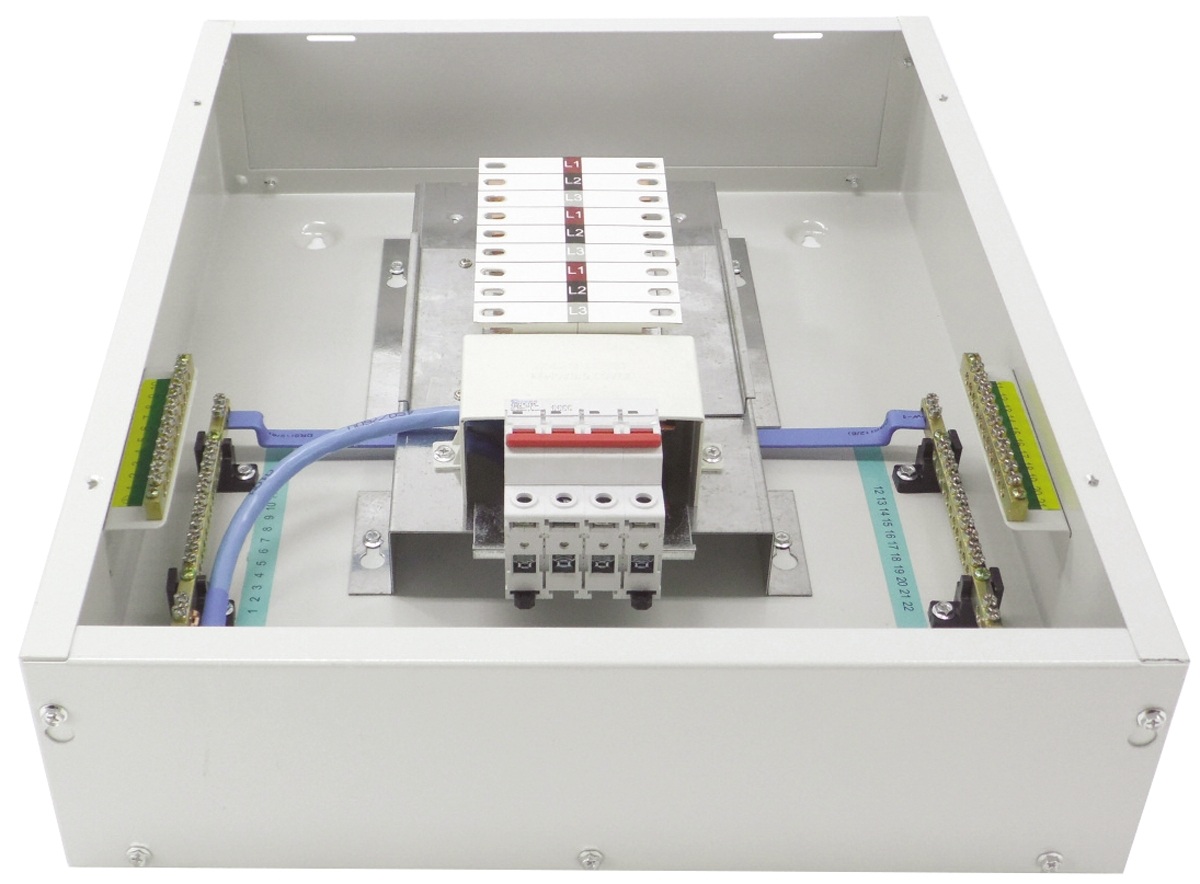
**Distribution board types** are classified by their position in the power distribution hierarchy and protection methodology. Whether specified as a DB panel, LV panel board, or consumer distribution unit, understanding these types helps engineers match specifications to project requirements.
Quick Comparison: Distribution Board Types
Type | Typical Rating | Application | Key Feature |
MDB | 400A – 6300A | Building main feed | Centralized control |
SDB | 125A–800A | Floor/zone distribution | Localized isolation |
Consumer Unit | 63A – 125A | Residential/small commercial | Integrated RCD |
Fuse Box | 32A – 100A | Legacy residential | Manual fuse replacement |
Main Lug | 225A – 1200A | Sub-panel feed | No main breaker |
Transfer Switch | 100A – 4000A | Dual-source systems | Auto/manual changeover |
Meter Panel | Varies | Multi-tenant buildings | Energy monitoring |
Main Distribution Board (MDB)
The Main Distribution Board receives the primary incoming supply from the utility transformer or generator and distributes power to multiple sub-distribution boards. It houses high-rated circuit breakers (MCCB or ACB) and serves as the central point for electrical isolation.
Industrial distribution boards of this type commonly operate at 400A to 6300A ratings. MDBs are standard in large commercial buildings, hospitals, manufacturing plants, and data centers where centralized protection and metering are required.
Sub Distribution Board (SDB)
Sub Distribution Boards are fed from the MDB and distribute power to final circuits within a specific floor, zone, or department. They enable decentralized control and reduce cable runs.
SDBs typically operate at 125A to 800A ratings. These distribution board types are standard in multi-story buildings, factories, shopping centers, and educational facilities.
Consumer Unit
A consumer unit is a residential or light commercial distribution board type that combines the main switch, RCD (Residual Current Device), and MCBs in a compact enclosure. These residential distribution boards are designed for single-phase or small three-phase installations.
Consumer units are standard in villas, apartments, small offices, and retail shops across the GCC region. Saudi electrical codes require RCD protection for all socket outlets, making integrated consumer units the preferred specification for residential projects.
Fuse Box
A fuse box is a basic form of distribution board that uses rewirable or cartridge fuses for overcurrent protection instead of circuit breakers. While less common in modern installations, fuse boxes remain in older residential and light commercial setups.
These panels require manual fuse replacement after a fault and offer limited flexibility compared to MCB-based systems. Building codes in Riyadh and Jeddah now restrict fuse box installation in new commercial projects due to safety and maintenance limitations.
Safety Alert:
Never specify fuse boxes for new commercial installations. Building codes in Riyadh and Jeddah require MCB/MCCB protection for insurance and fire safety compliance.
Main Lug Panel
Main lug panels do not include a main breaker. They receive power through lugs connected to an upstream protective device in the MDB or service entrance equipment.
These panels function as sub-panels in split-bus systems and industrial distribution networks, common when the main disconnect is located elsewhere.
Vertical Per-Phase Isolation DB
This distribution board type allows independent isolation of individual phases and is used in three-phase systems where selective phase control is needed. Engineers specify these panels in industrial plants with unbalanced loads or equipment requiring single-phase supply from a three-phase source.
Vertical per-phase isolation improves maintenance safety by allowing technicians to isolate one phase while keeping others energized. These three-phase distribution boards are common in manufacturing facilities, process plants, and heavy industrial applications.
Phase Selector DB
Phase selector distribution boards enable switching between different incoming phases or sources. They are used in buildings with multiple utility feeds or standby generator integration where operational flexibility is required.
These power distribution panel types provide manual or automatic phase selection. Applications include data centers, telecom facilities, and mission-critical infrastructure where load balancing or source redundancy is mandatory.
Enclosed Switchgear
Enclosed switchgear assemblies integrate switching, protection, and metering functions within a metal-clad enclosure. These distribution board types are suitable for medium- to high-current applications requiring robust isolation and arc flash protection.
Industrial distribution boards in this category are used in substations, industrial plants, and utility distribution networks. Enclosed switchgear provides Form 3 or Form 4 separation per IEC 61439-2, allowing safe maintenance with adjacent sections energized.
Transfer Switch
Transfer switch panels facilitate automatic or manual switching between two power sources, such as utility and standby generator. They maintain continuity of supply during outages and prevent backfeed into utility lines during generator operation.
These distribution board types are critical in hospitals, airports, data centers, and telecommunications facilities where uninterrupted power is non-negotiable. Automatic transfer switches (ATS) operate within 5-15 seconds of utility failure, while manual transfer switches require operator intervention.
Meter Panel
Meter panels house energy meters, current transformers, and associated metering equipment for monitoring and billing purposes. They are installed at the service entrance in multi-tenant buildings, shopping centers, and industrial complexes to track individual consumption.
These panels interface with utility billing systems and building management systems (BMS). Saudi Electricity Company (SEC) requires certified meter panels with tamper-proof enclosures for all commercial installations above 100 kW demand.
Single-Phase vs Three-Phase Distribution Boards
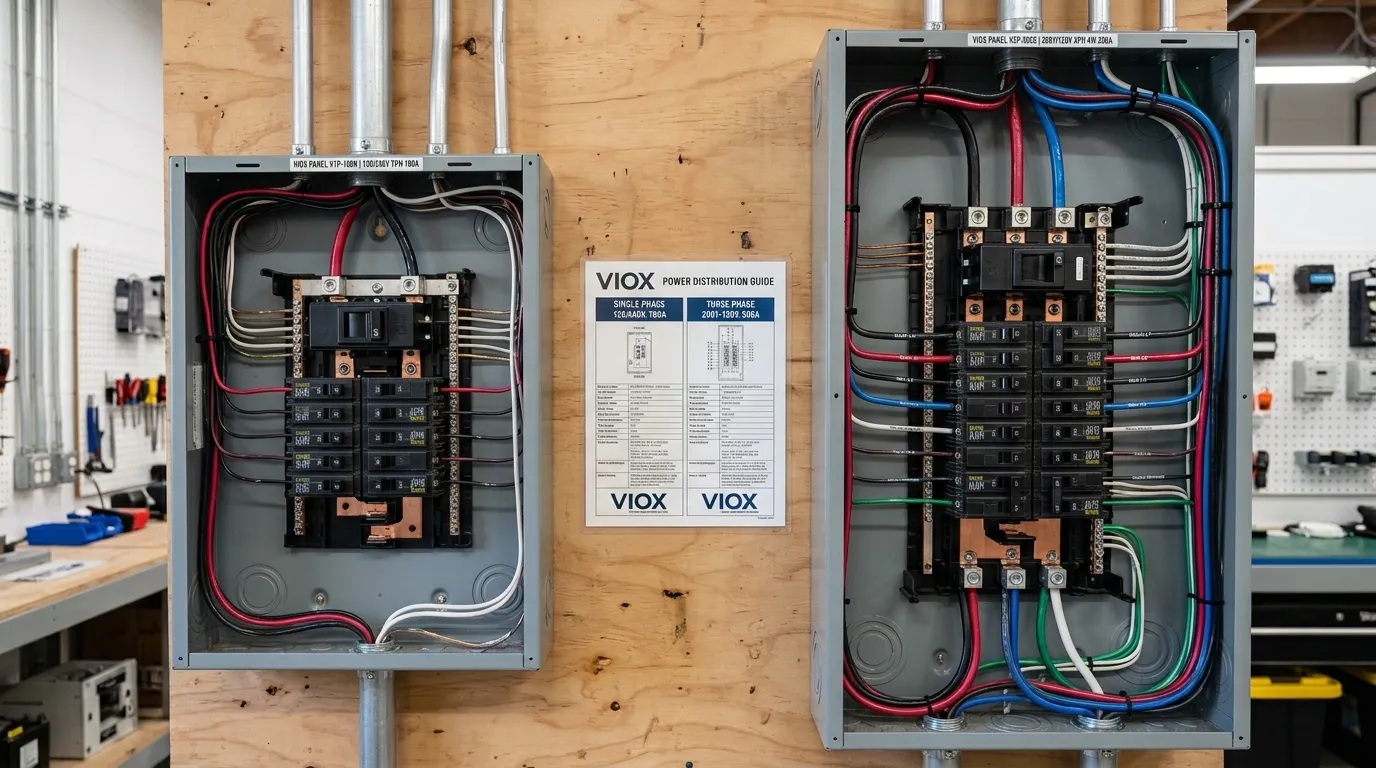
Single-phase distribution boards handle 230V supply for residential villas, small shops, and light commercial loads under 15 kW with MCB protection (6A to 63A).
Three-phase distribution boards manage 400V supply for industrial equipment, large HVAC systems, and commercial buildings, distributing power across three phases (L1, L2, L3) for balanced load distribution.
Building codes in Saudi Arabia require three-phase configurations above 20 kW total demand, making them mandatory for commercial and industrial projects.
Engineer’s Note:
In Saudi projects, always verify SASO stamp availability before procurement. Non-compliant panels delay project handover by 3-6 weeks on average.
Samman Group’s technical team assists engineers in determining the optimal phase configuration during design review, ensuring selected distribution board types match both current loads and future expansion requirements per Saudi building codes.
How to Choose the Right Distribution Board
When comparing distribution board types, engineers evaluate several critical factors:
- Load Capacity and Circuit Count:
- Consumer units: 63-125A for residential applications
- Sub Distribution Boards: 125-800A for floor/zone distribution
- Main Distribution Boards: 400A+ for building main feeds
- Number of outgoing ways: 4 to 96+, depending on circuit subdivision needs
- Protection Device Type:
- MCBs: Final circuits up to 125A
- MCCBs: Feeders from 100A to 1600A with adjustable trip settings
- ACBs: Main incomers above 800A with remote monitoring capabilities
- Form of Separation (IEC 61439-2):
- Form 1: No internal separation
- Form 2: Separation of busbars from functional units
- Form 3: Separation between functional units
- Form 4b: Complete separation for safe maintenance in energized panels
- Environmental Rating:
- IP20/IP30: Standard indoor installations
- IP54+: Outdoor or dusty environments
- IP65: Coastal projects (Jeddah, Dammam) with corrosion protection
Manufacturers like Samman Group provide selection assistance through their technical team, helping engineers match distribution board types to load profiles and project requirements. Their experience with Saudi building codes and SEC connection standards streamlines approval processes.
Need Expert Guidance on Distribution Board Selection?
Samman Group’s engineering team provides complimentary design review services for consulting firms and contractors specifying distribution board types in Saudi projects.
With 50+ years of experience navigating IEC standards, SASO certification, and SEC approval processes, their technical specialists help identify optimal configurations before procurement.
Contact Samman Group for specification verification and compliance pathway guidance.
Key Components Inside a Distribution Board
All distribution board types contain similar core components. Busbars (copper or aluminum) carry the main current and distribute power to outgoing circuits. Circuit breakers (MCB, MCCB, or ACB from ABB, Schneider Electric, or Siemens) provide overcurrent protection.
Neutral and earth bars maintain proper grounding per IEC 60364-4-41. Surge protection devices (SPDs) guard against transient overvoltages and are now mandatory in Saudi commercial panels above 100A. Digital meters enable load monitoring and BMS integration.
Safety Tips for Using Distribution Boards
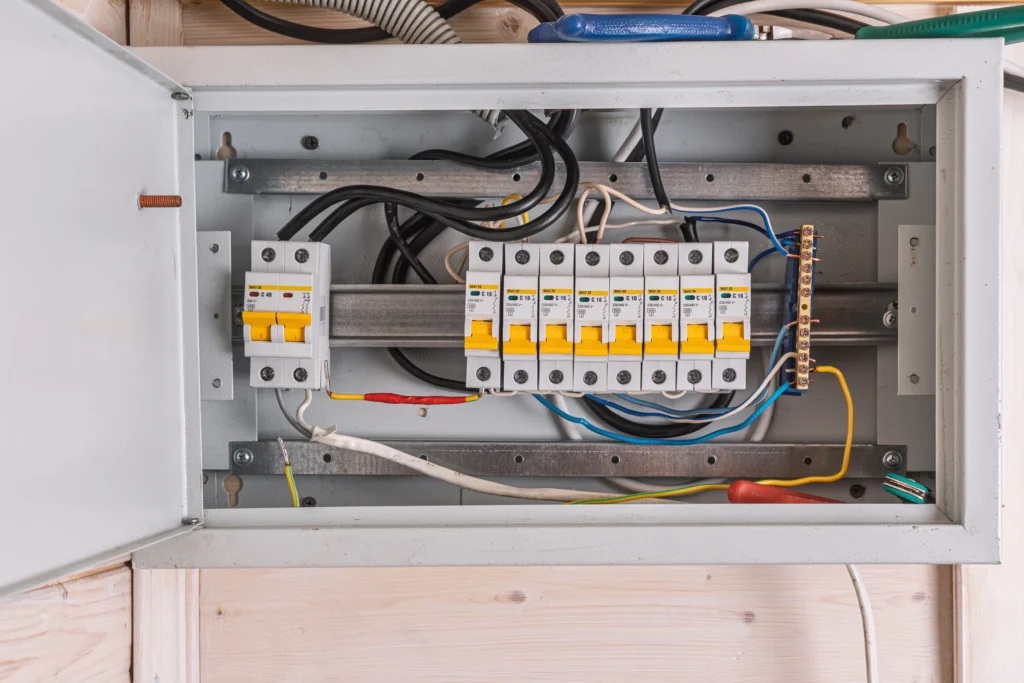
Critical safety practices across all distribution board types:
- Verify correct earthing and bonding during commissioning
- Conduct quarterly infrared thermal scanning to detect connection issues
- Never overload circuits or bypass protective devices
- Apply lockout/tagout (LOTO) procedures during maintenance
- Maintain IEC 61439 testing documentation for critical facilities
Al Samman Group panel deliveries include commissioning support and thermal baseline documentation. Their service teams conduct quarterly thermal scanning programs for critical facilities, identifying potential failures before they occur.
Distribution Board Sizes
Sizing depends on ampere rating (63A to 6300A), number of outgoing ways (4 to 96+), and future expansion needs. Wall-mounted panels suit loads up to 250A; floor-standing assemblies handle higher ratings.
Engineers specify 20-30% spare capacity for load growth based on detailed load schedules.
Procurement Tip:
Request type-tested assemblies per IEC 61439-2 rather than partially type-tested (PTT). Fully tested panels reduce commissioning issues by 60%.
Distribution Board Types PDF
Engineers and procurement teams commonly request distribution board types PDF documentation for:
Project Documentation Needs:
- Single-line diagrams showing panel configuration
- Component specifications and nameplate data
- Testing certificates (type tests and routine tests)
- Compliance declarations for IEC 61439 and SASO standards
Saudi-Specific Requirements:
For projects in Saudi Arabia, SASO-stamped documentation and IEC test reports are mandatory for final approvals from the Saudi Electricity Company (SEC) and municipal building departments.
Don’t let documentation delays extend your project timeline. Samman Group provides complete, authority-ready documentation packages within 48 hours:
- SASO-stamped certificates (verified and current)
- IEC 61439 test reports matching installed equipment
- Single-line diagrams formatted for SEC submissions
- Arabic/English technical datasheets
- Municipal building department approval support
Their documentation has supported successful approvals for thousands of Saudi projects since 1973—consultants trust their submittals because they’re prepared by engineers who understand local requirements.
Contact Samman Group for documentation that passes the first review and keeps your project on schedule.
Best Electrical Panel Manufacturer in Saudi Arabia
Selecting a reliable manufacturer for distribution board types requires evaluating technical capability, compliance readiness, and local support infrastructure.
Samman Group: Saudi Arabia’s Distribution Board Specialist
Samman Group, established in 1973, manufactures complete distribution board types from their Saudi facilities, from consumer units to 6300A main switchgear assemblies. With over 50 years serving GCC infrastructure projects, Samman Group provides:
Manufacturing Capabilities:
- Type-tested assemblies per IEC 61439-1 and IEC 61439-2
- SASO-certified panels with in-house testing laboratory
- Factory Acceptance Testing (FAT) for all project deliveries
- Custom engineering for special applications (hospitals, airports, industrial plants)
Local Presence:
- Technical offices in Riyadh, Jeddah, and Dammam
- 48-hour spare parts availability across Saudi Arabia
- On-site commissioning teams
- Arabic and English documentation
Proven Track Record:
Samman Group has supplied distribution board types for major Saudi projects, including commercial towers, industrial facilities, healthcare infrastructure, and government buildings. Their local assembly ensures compliance with SEC connection requirements and municipal approval processes.
For long-term reliability, Samman Group’s combination of manufacturing expertise, SASO compliance, and local engineering support reduces procurement risk and lifecycle costs.
Contact Samman Group for project-specific technical guidance on selecting the right distribution board types for your facility.
In conclusion, selecting among distribution board types requires balancing load capacity, protection requirements, and regulatory compliance. Main Distribution Boards anchor building systems, while Sub Distribution Boards enable zone control. Consumer units serve residential loads, and transfer switches maintain continuity.
In Saudi Arabia, IEC 61439 and SASO certification are mandatory. Samman Group has provided locally manufactured distribution board types with proven reliability across GCC infrastructure projects since 1973.
Understanding distribution board types and their applications maintains safe power distribution throughout facility operations. For project-specific guidance, consult manufacturers with Saudi engineering expertise and SEC approval experience.
FAQs
How many types of distribution boards are there?
There are 10 main distribution board types commonly specified in electrical systems: MDB, SDB, consumer units, fuse boxes, main lug panels, vertical per-phase isolation boards, phase selector boards, enclosed switchgear, transfer switches, and meter panels.
Each type serves specific functions in LV power distribution based on load capacity, protection requirements, and installation context.
What are the three main types of distribution?
The three main distribution board types in power hierarchy are Main Distribution Boards (MDB) that receive incoming utility supply, Sub Distribution Boards (SDB) that distribute power to specific zones or floors, and final circuit distribution units such as consumer units or fuse boxes that supply end-use equipment.
What is the difference between single-phase and three-phase distribution boards?
Single-phase distribution boards handle 230V supply for residential and light commercial loads under 15 kW, while three-phase distribution boards manage 400V supply for industrial equipment and commercial buildings with balanced load distribution across three phases (L1, L2, and L3) plus neutral.
Which manufacturer provides SASO-certified distribution board types in Saudi Arabia?
Samman Group manufactures complete IEC 61439-certified distribution board types from their Saudi facilities with full SASO compliance. They offer local engineering support in Riyadh, Jeddah, and Dammam with 48-hour spare parts availability and on-site commissioning services.